Books I recommend
Here's a place to learn about other authors whose work I've read and enjoyed.
Please feel free to send me your work for review, or share any reviews on my page.
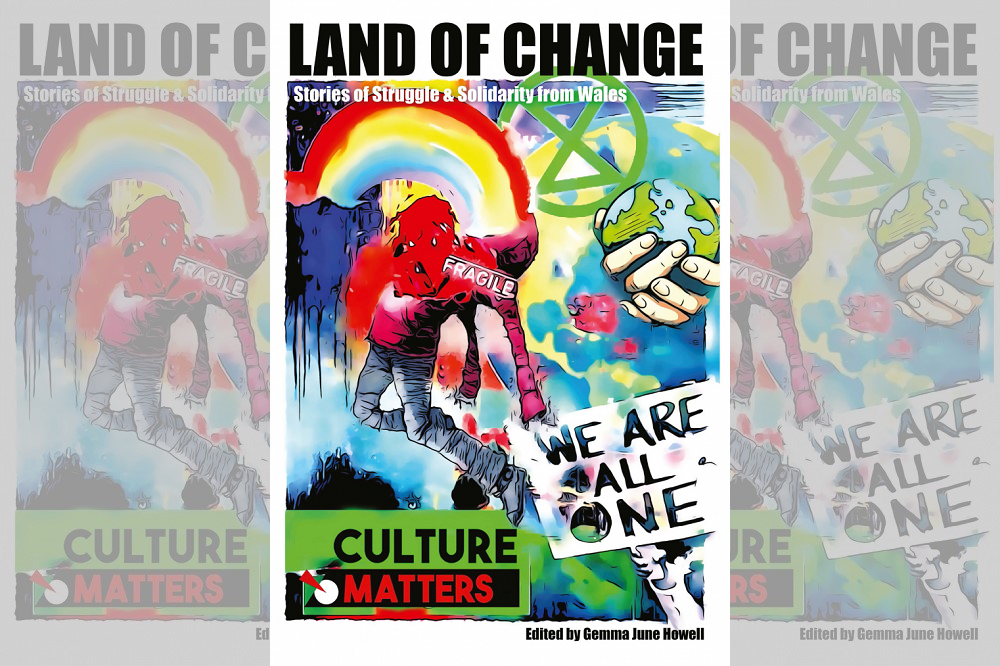
Land of Change: Stories of Struggle and solidarity from Wales,
edited by Dr Gemma June Howell
Land of Change: Stories of Struggle and Solidarity from Wales is an anthology celebrating Welsh working class writing and culture. But it is so much more than that. It’s a vivid snapshot of the world we are living in, with all its struggles and triumphs, and a clarion call to those in positions of power to hear the voices of the under-represented, under-privileged and marginalised.
There are seventy-nine contributions, each with their own distinct cultural and lived experiences who share a connection with Wales. The book contains reflections on lived experiences that include racism, gender, activism and wealth inequality. There are recollections of past events such as the 1980s miners strike and, more recently, Brexit, the Me Too movement and Black Lives Matter. The overall message , however, is far from pessimistic but celebratory of the power of collective action to effect change, a challenge summed up in Gwenno Dyfydd’s song which concludes the book:
‘”Don’t give up hoping…
Don’t despair
The winds of change are blowing
And a gale is on its way.”
Land of Change: Stories of Solidarity and Struggle from Wales is published by Culture Matters. It is available at www.culturematters.org.uk
Under The Raging Moon (one night with Dylan Thomas in Greenwich Village, New York) A Drama in Four Acts by Peter Thabit Jones
There have been many books written about Dylan Thomas, but few have dared try to capture the character of Wales’s best-known bard. This book, a play in four acts, sets out to do exactly that. The action takes place on October 1953, the night before Dylan’s untimely death. In an imagined scenario, Dylan has just been kicked out of a taxi by his disgruntled lover Liz Reitell and stops off at a series of bars, ending with The White Horse Tavern in Greenwich Village. Along the way, he chats with local characters and shares his views on, amongst other things, parenthood, money and death.
Attempting to capture Dylan Thomas in dialogue is a brave feat – especially given his fame and the number of myths surrounding the man. But Peter Thabit Jones does a good job of depicting the Welsh poet as both a skilled wordsmith and raconteur who is at the same time vulnerable and, at times, quite self-deprecating. There are parts of the dialogue I recognised as being ‘Dylanesque’ from his letters – such as Dylan’s description of Laugharne with its ‘Christmas cracker of characters’. Others, such as the discussion on wealth, take their inspiration from what is known of Dylan’s background, in particular his friendship with the ‘communist grocer’ Bert Trick. The deeper conversations are interspersed with moments of levity. There’s a hilarious incident where the increasingly tipsy poet dances with another man’s wife and ends up spreadeagled on the floor – pure Dylan slapstick humour.
Does the play succeed in a realistic portrayal of Dylan Thomas the person, not just Dylan the poet? Without a time machine, we’ll never know, but it certainly fitted with what I imagine must have been the character of a man who could be both genius and clown by turns (and sometimes both at once!)
Under The Raging Moon by Peter Thabit Jones is published by Cross Cultural Communications and The Seventh Quarry Press.


‘The Ear of Eternity’ by Xavier Panades I Blas
Xavier Panades i Blas is a Catalan-born poet now living in Wales. ‘The Ear of Eternity’ is his first collection, exploring the world of the Catalonian exile, where themes of the environment, Catalan identity, time, music and belonging mix with intensely personal experiences and wider political reflections. The book is published in Catalan with translations into English.
The Ear of Eternity is a collection where the personal and political meet without division or delineation, both acutely intimate and universal. Often the rhythm of the poems feels elegiac or song-like, as for instance in the repeated refrain of Eternity: ‘We’re hiding it forever, between dreams and vices. ‘But Xavier’s style can also be angry and bombastic, or quietly philosophical. One of my favourite poems in the collection is the simple yet profound ‘Teachers’, which says so much in just a few simple verses, and ought to be sent to every teacher as an appreciation of their art.
Overall, I found this to be a stimulating and enjoyable collection. There are many poems I have found myself going back to multiple times, with phrases that lodge in the head and demand further reflection, such as the wonderful line from ‘The Other Catalans’: ‘we cry for our brothers killed by the arms of your soldiers to steal the black oil – the soul of the darkness’. These are not dry, dusty academic poems to be read once then placed on a shelf and admired. These are poems to be lived, breathed and inhabited.
(A longer version of this review appeared on www.inksweatandtears.co.uk)
Poetry for the Feeble Minded, by KG Miles
Reading this collection is an oddly disconcerting experience, like eavesdropping on the stolen conversations and fever dreams of a lost generation. This first poetry collection by KG Miles, co-author of ‘Bob Dylan and Dylan Thomas’ (KG Miles and Jeff Towns) takes us into a largely forgotten world, that of the asylums and hospitals used to house those deemed ‘feeble minded’ – ‘the Poor, Criminals, Epileptics, the Insane, the Constitutionally Weak, the Deaf, Blind or Deformed, Imbeciles, Idiots Sexual Perverts, Inebriates, Degenerates, Prostitutes, Tramps, Morons, Cretins and Persons of Every Colour But Magnolia’.
The poems are inspired by original documents portraying real people and events. We hear such voices as Miss Phoebe B Davis, who sold her furniture to buy clothes to keep her warm, and The Kallikal Girl, a so-called ‘Feeble Minded Girl’, whose whole life seems to have existed merely as a subject for scientific observation.
Interspersed with these acutely observed and tenderly-voiced accounts come the jocular meetings of the Scientists, the ‘Rich White Men With Whiskers’, a gathering of the Great and the Good at the First International Conference on Eugenics in London 1912, whose members include The Right Hon Winston Churchill, The First Lord of the Admiralty, The Rt Hon The Major of London and Dr Alexander Graham Bell.
This is a clever and subtle collection which doesn’t overplay its hand but lets the facts and characters speak for themselves. At times, I found the language and subject matter uncomfortable – use of terms such as ‘feeble-minded’ ‘moron’ and ‘negroes’ in close context is bound to be offensive to a modern-day audience – but that is the point. Reading about Eugenics is never supposed to be comfortable. This is an important part of our history that needs to be faced up to. To quote 20th Century philosopher George Santayana ‘Those who do not learn history are doomed to repeat it’. May we read and learn.
(A longer version of this review appeared in The Seventh Quarry magazine.

Create Your Own Website With Webador